
Island hopping in the Philippines: a dry season guide
27 October 2026 • Brooke MackenzieThe Philippines has more than 7,000 islands, and ferries link a surprising number of them. The trick is timing. Go in the dry season and you get calm mornings on the water, clear days for snorkeling and boat trips that run on schedule. Go at the wrong time and you could spend part of your vacation waiting out a storm warning at the port.
The short answer: the dry season in most of the Philippines runs from about December to May. December to February is cooler but can be windy at sea. March to May is hot, with the calmest water of the year. That makes March to May the best window for island hopping, and December to February a good second choice if you can live with the odd choppy crossing.
This guide covers when to go, three island-hopping routes that work well in the dry season, and how to plan the ferries in between. You can compare and book many of these routes on Ferryscanner. You’ll pay the same price as booking direct, earn Ferryscanner Miles to put toward future trips, and get help from our customer service team 7 days a week if your plans change.

Start your adventure in Cebu. Source: iStock
When is the dry season in the Philippines?
The dry season in the Philippines runs from about December to May, with the driest months usually February to April. It splits into two parts:
- Cool dry season (December to February): temperatures are a little lower and humidity drops. The northeast monsoon (known locally as amihan) brings steady winds, so some sea crossings can be rough and the occasional trip gets canceled.
- Hot dry season (March to May): the hottest months, often above 30°C (86°F), but with the least rain and the calmest seas. This is the easiest time to hop between islands by boat.
The wet season runs from about June to November, when the southwest monsoon (habagat) brings heavy rain. Typhoons are most common from about July to October, but they can arrive as late as November or December, so keep an eye on forecasts if you’re traveling early in the dry season.
What’s the best time for island hopping in the Philippines?
The best time for island hopping in the Philippines is March to May. Rain is rare, the sea is usually at its calmest, and boat tours and ferries rarely get canceled. The trade-off is heat, and crowds around Holy Week (the week before Easter), when many Filipinos travel and ferries and hotels fill up fast.
January and February are a good alternative, especially if you don’t love intense heat. Just leave a spare day in your plans in case a windy spell holds up a crossing.
Weather also varies by region, and a few places don’t follow the national pattern:
- Palawan (El Nido and Coron): dry from about December to May. March to May has the calmest seas for island-hopping tours and the El Nido to Coron crossing.
- Cebu, Bohol and Siquijor: dry from about January to May. Sheltered seas in this part of the Visayas mean ferries tend to run reliably for most of the year.
- Boracay: dry from about November to May. During these months, White Beach sits on the sheltered side of the island and the water is usually flat.
- Siargao: this east-facing island is the exception. It gets a lot of rain from about November to January, and its drier months tend to fall between March and September. Surfers usually come in the late wet season, from about August to November, when the swell is biggest.
Which islands should you visit in the dry season?
Three routes work especially well in the dry season. Each one links islands that are a short ferry ride apart, so you spend more time on land and less time in transit.
Route 1: Cebu, Bohol and Siquijor (the Visayas loop)
This is the easiest route for first-timers. Ferries run often, crossings are short, and each island feels different.
- Cebu: fly into Mactan-Cebu International Airport. Spend a day or two in the city, or head south for waterfalls and snorkeling.
- Bohol: take a fast ferry from Cebu to Bohol, which takes about 2 hours. Stay on Panglao Island for beaches and diving, and visit the Chocolate Hills and the tarsier sanctuary inland.
- Siquijor: catch the ferry from Bohol to Siquijor. Siquijor is small and quiet, with waterfalls, caves and easy snorkeling. A scooter is the best way to get around.
- Dumaguete: finish with the short hop from Siquijor to Dumaguete on Negros, which has an airport with flights back to Manila and Cebu. Or take the Siquijor to Cebu ferry to close the loop.
Plan for 10 to 14 days. If you want to add another island, Bohol to Camiguin is a good detour for volcanoes and hot springs.
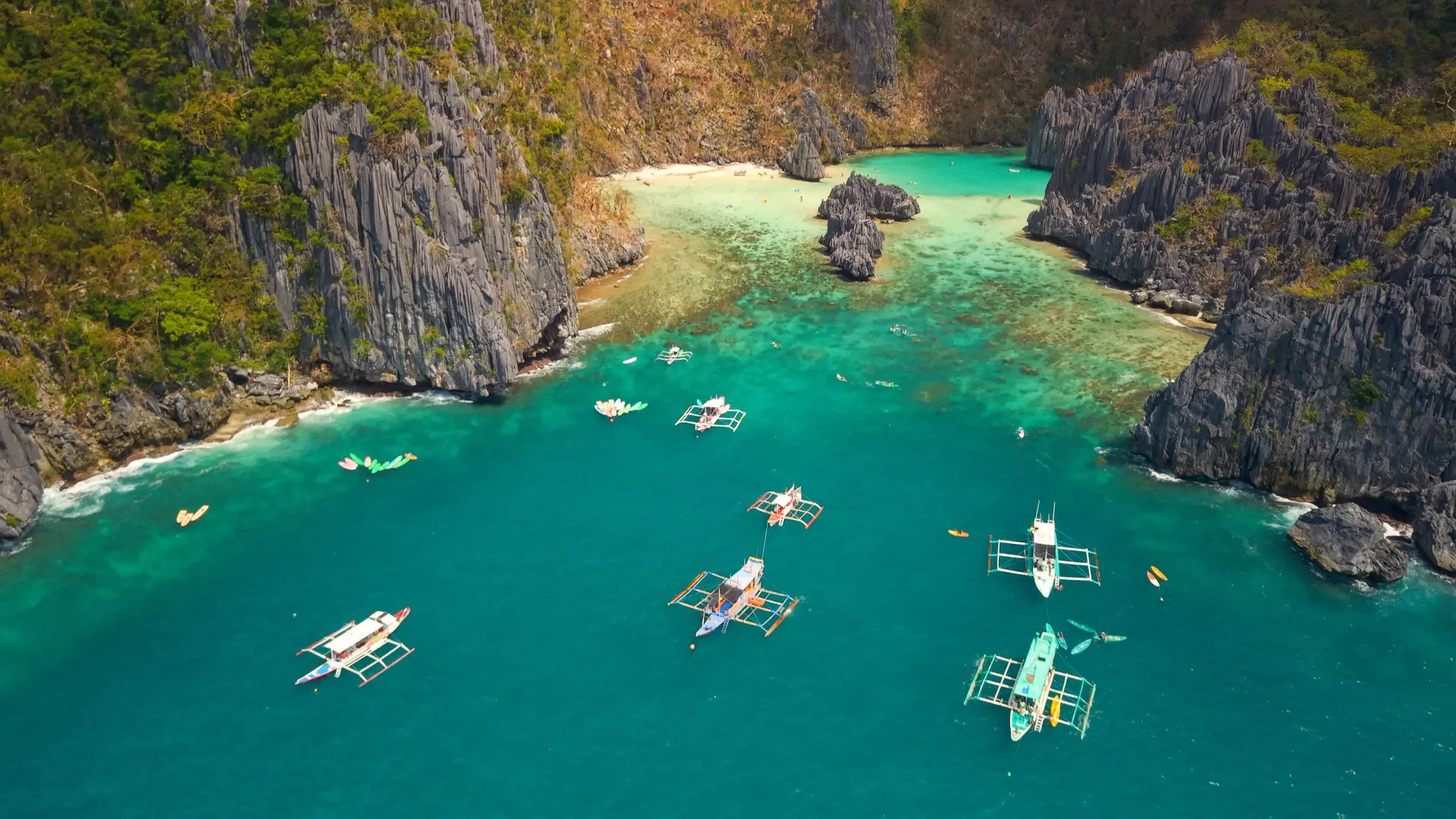
In the Philippines, you get from place to place by sea. Source: iStock
Route 2: El Nido and Coron (Palawan)
Palawan is the classic Philippines island-hopping trip. It’s known for limestone cliffs, lagoons and well-known wreck diving around Coron. It also depends more on good weather than the other routes, which is why the dry season matters most here.
- El Nido: most people fly to El Nido or to Puerto Princesa, then take a long van ride north. You can also take a ferry from Manila to El Nido. Spend three or four days doing the lettered island-hopping tours (Tours A to D) around Bacuit Bay.
- Coron: take the fast ferry from El Nido to Coron, which takes about 4 hours across open water. This is the crossing most affected by wind, so March to May is the most comfortable time to do it. In Coron, visit Kayangan Lake and Twin Lagoon, or dive the Japanese shipwrecks from World War II.
- Back to Manila: fly out of Busuanga, or take the ferry from Coron to Manila.
Plan for 7 to 10 days. You can also do this route in reverse, starting with the Manila to Coron ferry.
Route 3: Mindoro and Boracay (south of Manila)
This route suits travelers who want to avoid domestic flights or add some beach time near Manila.
- Puerto Galera (Mindoro): take a bus from Manila to Batangas port, then the ferry from Batangas to Mindoro. The crossing to Puerto Galera takes about 1 to 1.5 hours, and the area is known for easy-going beaches and good diving.
- Boracay: continue south by ferry from Mindoro to Caticlan, the jumping-off point for Boracay. From Caticlan, a short boat takes you across to the island. You can also go straight from Batangas to Caticlan.
Plan for 5 to 8 days. Boracay is at its best from November to May, when White Beach is sheltered from the wind.
What about Siargao?
Siargao fits a different calendar from the rest of the country, so it’s better as a separate trip than as part of a dry-season loop. If you’re going between March and September, you can fly in directly or take the ferry from Surigao to Siargao, which takes about 2 to 3 hours.
How do ferries work in the Philippines?
Ferries in the Philippines range from fast passenger boats (often called fast craft) to large overnight ships that carry cars and cargo. For island hopping, you’ll mostly use fast craft on routes like Cebu to Bohol and Bohol to Siquijor. Bigger ships are more common on long routes, such as Manila to Palawan.
A few things are worth knowing:
- Bring your passport or ID. You’ll need to show it at check-in, and the name must match your booking.
- Arrive early. Aim to get to the port at least an hour before departure. Some ports also charge a small terminal fee in cash.
- Weather cancellations happen. The Philippine Coast Guard stops sailings when the sea is too rough, even in the dry season. Leave a buffer day before any flight home.
- Book ahead for holidays. Holy Week, Christmas and New Year are the busiest times on the water. Book your ferries as soon as your dates are fixed.
For more on the main crossings, see our guide to the best ferry routes in the Philippines.
How long do you need to island-hop in the Philippines?
Two weeks is enough to island-hop comfortably in one region of the Philippines, such as the Visayas loop or Palawan. With three weeks, you can combine two regions, for example Palawan and the Visayas, linked by a domestic flight through Manila or Cebu. If you only have a week, pick one route and two or three islands.
Distances in the Philippines are bigger than they look on a map, and getting between regions usually means flying. It’s better to go deep in one area than to try to see everything.

Come December, this could be you! Source: iStock
FAQs
When is the dry season in the Philippines?
The dry season in the Philippines runs from about December to May. December to February is the cool dry season, with steady winds at sea. March to May is the hot dry season, with the least rain and the calmest water. The wet season runs from about June to November.
What is the best month to go island hopping in the Philippines?
March and April are usually the best months for island hopping in the Philippines. The weather is dry, the sea is at its calmest and boat tours rarely get canceled. Book early if you’re traveling around Holy Week, as ferries and hotels fill up quickly.
Is December a good time to visit the Philippines?
December is a good time to visit most of the Philippines, as it marks the start of the dry season. Expect cooler temperatures, stronger winds at sea and busy holiday crowds around Christmas and New Year. Late typhoons are possible, so check the forecast before you travel.
When is typhoon season in the Philippines?
Typhoons can hit the Philippines in any month, but they’re most common from about July to October. Late-season storms sometimes arrive in November or December. They’re much less common from February to May.
Can you island-hop in the Philippines in the rainy season?
Yes, but expect more cancellations and fewer sunny days. Short, sheltered crossings like Cebu to Bohol usually keep running. Longer open-water routes like El Nido to Coron are more likely to be disrupted. Leave extra days in your plans and buy flexible tickets where you can.
Do you need to book ferries in advance in the Philippines?
For most routes, booking a few days ahead is enough. Book as early as you can for Holy Week, Christmas and New Year, when ferries on popular routes often sell out.
Why book your Philippines ferries with Ferryscanner?
Once you’ve picked your islands, the next step is booking the ferries between them. It’s worth doing early if you’re traveling around Holy Week, Christmas or New Year. On Ferryscanner, you can compare times, prices and ferry companies for routes across the Philippines in one place, then book your tickets online.
Here’s what you get when you book with us:
- The same price as booking direct: you don’t pay extra to compare and book on Ferryscanner.
- Ferryscanner Miles on every booking: you earn Miles each time you book, and you can use them to save on future trips.
- Real people when you need them: our customer service team responds in about 40 seconds, 7 days a week, if you need help changing or canceling a booking.
- One account for every trip: we cover more than 6,000 routes and 350 ferry companies worldwide, so you can book your next island trip in the same place.
When you’re ready, search your first route on Ferryscanner to see what’s running on your dates.
More Articles
View all Uncategorized articles
Ferries from Croatia to Italy: Routes, Prices & Travel Tips
26 February 2025
Sail from Croatia to Italy with ease! Discover ferry routes from Split, Pula, Rovinj, and Dubrovnik to Italy’s top destinations like Venice and Ancona. Compare schedules, prices, and travel tips to plan your Adriatic crossing.

Koh Samui, Koh Tao or Koh Phangan — which Thai island is for you?
13 October 2026
Three islands, about an hour apart by ferry, each with a very different feel. Here's how to pick between Koh Samui, Koh Phangan and Koh Tao.